

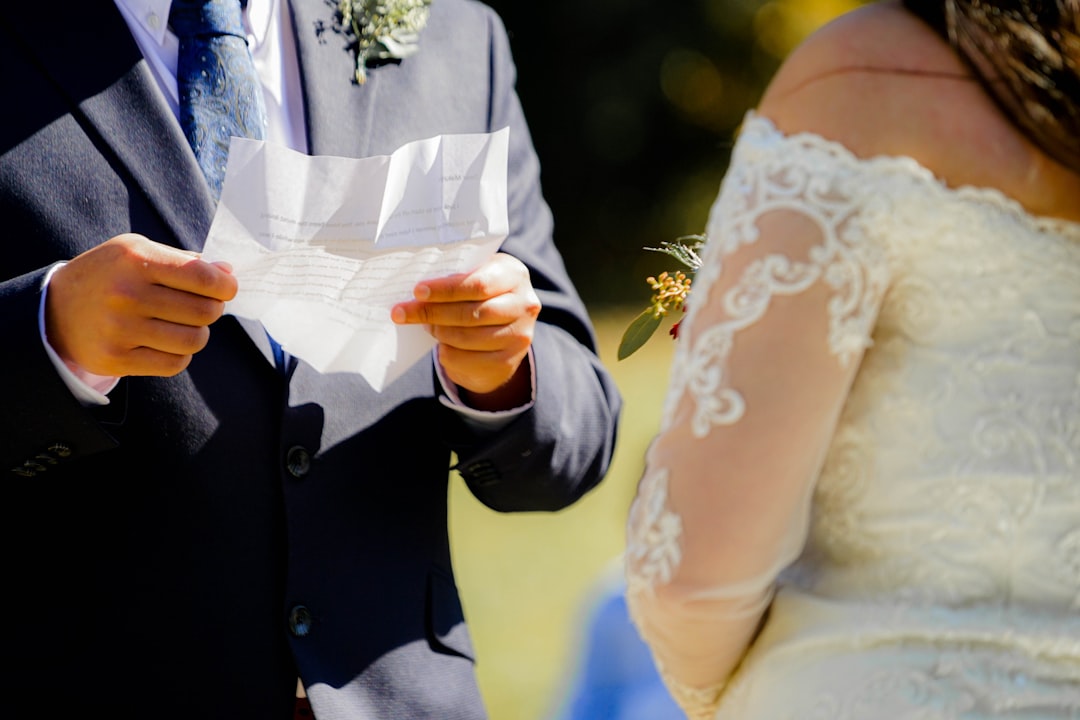
Joint Best Man Speech: Two Speakers, One Great Toast
You and your co-best man have decided to share the mic, and now you're both panicking slightly. Who writes what? Who goes first? How do you avoid sounding like a bad morning radio duo? And how do you make sure the room laughs with you instead of waiting for you to finish?
A joint best man speech is actually one of the most fun speeches to deliver, if you build it right. You get to play off each other. You get to share the nerves. You get twice the stories and half the individual pressure. The catch: a bad joint speech is worse than a bad solo speech, because bad timing between two speakers is painfully obvious.
This guide walks through nine practical tips for writing and delivering a joint best man speech that feels tight, warm, and deliberate. Two voices, one toast.
Table of Contents
- 1. Decide the Structure Before You Write a Word
- 2. Pick a Central Bit
- 3. Write in Chunks, Not Ping-Pong Lines
- 4. Use Each Speaker's Strengths
- 5. Cap It at 8 Minutes
- 6. Rehearse Physically, Not Just Verbally
- 7. Share One Notecard
- 8. Land a Single Toast at the End
- 9. Plan Your Exit
- FAQ
1. Decide the Structure Before You Write a Word
There are really only three structures that work for a joint best man speech:
- Opposing angles. Speaker A is the old friend, Speaker B is the brother. You alternate perspectives on the same guy.
- Chronological handoff. Speaker A covers childhood through college. Speaker B covers adult years and meeting the partner.
- Setup and payoff. Speaker A sets up a premise or running joke. Speaker B keeps landing the payoffs.
Pick one. Do not mix them. Two brothers named Jake and Eli tried to mix all three at a wedding I helped with, and it turned into a 12-minute identity crisis. Pick the structure that matches your actual relationship to the groom and commit.
2. Pick a Central Bit
A joint best man speech needs one central bit — a thread, a running gag, a repeated phrase — that ties both speakers together. Without it, the speech feels like two short speeches glued at the spine.
Good central bits we've seen work:
- A list that both speakers add to ("Reasons we love Daniel: I'll start.")
- A specific childhood nickname that keeps getting called back
- A fake competition ("I'm going to prove I'm the real best man by the end.")
- A shared inside joke the groom will immediately recognize
Here's the thing: the bit doesn't have to be clever. It has to be consistent. One idea, used three or four times, is stronger than three clever ideas used once each.
3. Write in Chunks, Not Ping-Pong Lines
New writers always want to alternate every sentence. Resist that. A one-line back-and-forth sounds like a sitcom bit and reads as gimmicky.
Instead, write in chunks of 30 to 60 seconds per speaker. Long enough to tell a real story, short enough that the other speaker stays engaged and the audience stays awake.
A good rough structure for a 7-minute speech:
- Speaker A opens (45 seconds)
- Speaker B responds with their angle (45 seconds)
- Speaker A tells the first real story (60 seconds)
- Speaker B tells the second real story (60 seconds)
- Speaker A turns to the partner (45 seconds)
- Speaker B lands the close and toast (45-60 seconds)
Notice that each speaker gets roughly equal airtime, and the emotional turn happens in the back half.
4. Use Each Speaker's Strengths
You and your co-speaker are not the same person. One of you is probably funnier. One of you is probably more comfortable on a mic. One of you probably cries at dog movies.
Write to your strengths. If you're the emotional one, you take the partner section. If your co is quicker with jokes, give them the opener and the callbacks. Playing against type almost never works under wedding pressure.
A real example: when Marcus and Theo delivered a joint best man speech for their friend Daniel, Marcus had done stand-up in college and handled every joke. Theo was a middle school teacher and handled every genuine moment. The speech worked because they stopped pretending they were interchangeable.
5. Cap It at 8 Minutes
Two speakers feels longer than one. Psychologically, an audience's patience resets each time a new voice takes over, but only partially.
Cap your joint best man speech at 8 minutes. Six is better. If you're running over in rehearsal, cut — do not convince yourselves the audience will want more because "there are two of us." They won't.
The truth is: nobody has ever said "that wedding speech should have been longer." They have definitely said the opposite.
6. Rehearse Physically, Not Just Verbally
Joint speeches live or die in the handoffs. You need to rehearse the physical choreography, not just the words.
Figure out:
- Where does each speaker stand? Shoulder to shoulder? One at the mic, one a step back?
- How do you hand off? A nod? A turn of the body? Do you share a single mic or each have one?
- What does the silent speaker do? (Don't stare at your feet. Look at the audience. React to what the speaking partner is saying.)
Rehearse standing up, in the clothes you'll wear, at least three times. If the groom is available to watch a run-through the night before, take him up on it. A best man speech for a brother you've known forever still benefits from one live rehearsal. If you don't know the groom as well and are working harder to find material, the rehearsal matters even more — see our notes on a best man speech when you don't know them well.
7. Share One Notecard
Both speakers should hold an identical card. Mark each speaker's lines clearly (bold for you, regular for your partner). That way if either of you freezes, the other can step in and cover without reaching across for a note.
Keep the card to bullet points, not full scripts. Eye contact matters more than word-perfect phrasing, especially when two of you are trying to stay synchronized.
If one of you is an introvert, this card becomes especially valuable — it's the safety net. We wrote more about managing the nerves in our introvert best man speech post and the nervous best man speech post.
8. Land a Single Toast at the End
One toast. One glass raise. One set of names.
The worst joint speeches end with both speakers trying to toast simultaneously, which means nobody toasts cleanly. Decide in advance who closes. That speaker delivers the "please raise your glasses" line and the names. The other speaker just lifts their glass.
A clean closer looks like this:
Speaker B: "Daniel, Jenna — we're grateful to be standing up here for you tonight. Please raise your glasses. To Daniel and Jenna."
Both speakers drink. Both sit down. Done.
9. Plan Your Exit
Sit down at the same time. Don't have one speaker linger at the mic while the other wanders back to the table. It looks unplanned, and a joint speech should feel choreographed.
Quick note: if you're the type to get swept into a hug from the groom mid-exit, that's fine. Just both commit to the same plan: hug him, then both sit. Not one of you hugging while the other stands there holding a napkin.
If your co-best man is flying in from out of town and you've only been able to rehearse over FaceTime, schedule one hour together the day before the wedding. See our long-distance friendship best man speech post for why that in-person rehearsal is non-negotiable, and if it's a second marriage there are a few extra sensitivities worth reading about in our second marriage best man speech post.
FAQ
Q: How long should a joint best man speech be?
Six to eight minutes total, not "five minutes each." Two speakers feels longer than one, so the ceiling is tighter than a solo speech.
Q: Should we alternate lines or take bigger turns?
Bigger turns. Aim for chunks of 30-60 seconds per speaker. Ping-ponging every sentence feels like a skit and kills the warmth.
Q: Who goes first?
Whoever has the stronger opener. It is almost never "the older brother" by default. Pick the stronger hook and let the closer have the stronger ending.
Q: Do we need matching notecards?
Yes. Both speakers should hold the same cue card with both parts marked. If one of you freezes, the other can rescue the moment.
Q: What if we disagree on a joke?
Cut it. A joint speech only works when both of you can deliver every line without wincing. If one of you is uncomfortable, the audience will feel it.
Need help writing your speech? ToastWiz uses AI to write a personalized wedding speech based on your real stories and relationship. Answer a few questions and get 4 unique speech drafts in minutes.